
Craft AI products

Design, build, and scale AI-powered products.

More than a feature, AI is a Product decision. We help you build AI products that earn user trust and ship to production while creating real business value.


Capa 01
2dev

AI is a Product decision.

Building an AI product (or embedding AI into an existing one) requires a different approach. Product teams work alongside data scientists and ML engineers, not just developers. Prioritization means weighing whether a 3% model improvement is worth spending weeks on it. For GenAI products, the output is non-deterministic: the same input can produce different results, reshaping the entire approach.

Above all, it reshapes the relationship with the user. Building user trust with a non-deterministic product is a discipline in itself.

That trust is earned in the Design layer: how the product communicates uncertainty and explains its suggestions, how it recovers when it's wrong... Explainability and graceful failure are among the first Product decisions you make.

We come from Product. That means we start from the user problem and work backward to determine where AI creates real value, and where it doesn't.

With GenAI, the same input produces different outputs - changing how products should be built

Users don't adopt AI features they can't understand or trust

When users don't understand why a product gives a certain answer, they stop using it. When they can't override it, trust collapses. And when it fails without explanation, they leave.
Building user trust with a non-deterministic product is a discipline in itself, earned in the Design layer: how the product communicates uncertainty and explains its reasoning, as much as how it recovers when it gets it wrong. Explainability and graceful failure are among the first Product decisions you make.

Collaboration isn't enough: PMs, data scientists, and ML engineers must co-own the product

A traditional Product team is a PM, a few engineers, and a Designer. An AI product adds data scientists, ML engineers, and evaluation specialists to the mix, each optimizing for different metrics and speaking a different language.
The PM arbitrates between model accuracy, user experience, infrastructure cost, and Time-to-Market all at once. This goes beyond adding a new member to the squad: it's a different collaboration model entirely.

A 3% model improvement may not be worth three weeks of engineering time, and your PM needs to know the difference

Traditional product prioritization weighs impact against effort. AI product prioritization adds a layer: is a 3% improvement in model accuracy worth three weeks of engineering time, knowing those same three weeks could go to improving the UX, enriching the training data, or cutting inference costs?
The backlog covers model performance, user experience, and infrastructure at once. Most product frameworks don't account for this – you need new ones.

Evals, drift detection, and cost control are the guardrails that keep an AI product alive

While a traditional product ships and stabilizes in maintenance mode, an AI product ships and immediately starts drifting: the data the model was trained on becomes stale, and performance degrades without anyone changing a line of code.
User feedback feeds directly into model retraining and eval datasets, improving the product as it runs. Model quality evaluation is a permanent practice, and cost optimization (from model selection to inference trade-offs) is an ongoing Product decision.

img

Some AI products we worked on

Our resources on building AI products

Everything you need to successfully integrate AI into your products.

EVENTS Rectangle 3463801

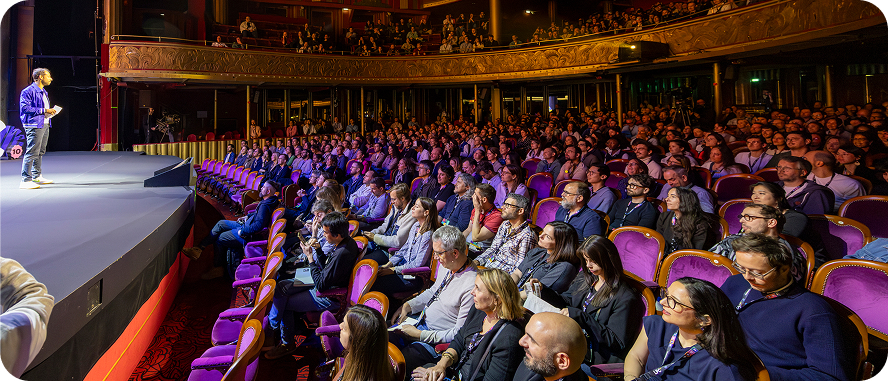
From La Product Conf - France's biggest Product event with over 1,300 attendees - to our VIP dinners, breakfast sessions and meetups, we bring Product people together around the topics that matter: AI, Product strategy, Design, organization and craft.

AI CANVAS AIPRODUCTCANVAS

Our tool to help Product teams frame AI initiatives and decide where AI creates real value.

AI FRAMEWORK UX Evaluation Framework EN
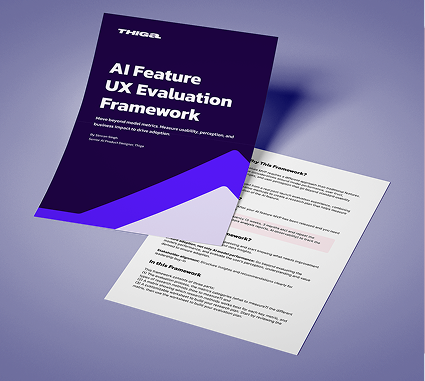
Go beyond model performance. This framework measures usability, user perception, and business impact of your AI features post-launch.

Article
06 FEBRUARY 2026

Artificial intelligence: why the c(h)at didn't get TheFork's tongue

How TheFork ditched their chatbot for AskTheFork, an AI-powered single-shot search that outperformed classic search with a 5% higher conversion rate across five European markets.
REPLAY Miniature Ravi Meta

Ravi Mehta (ex-CPO Tinder, co-creator of Reforge's AI Strategy program) on building AI products with durable competitive moats, from the La Product Conf 2025 stage.

Craft AI Products

Ready to build AI products your users actually trust?

Tell us what you're building and we'll see how we can help.

700