01
Personas
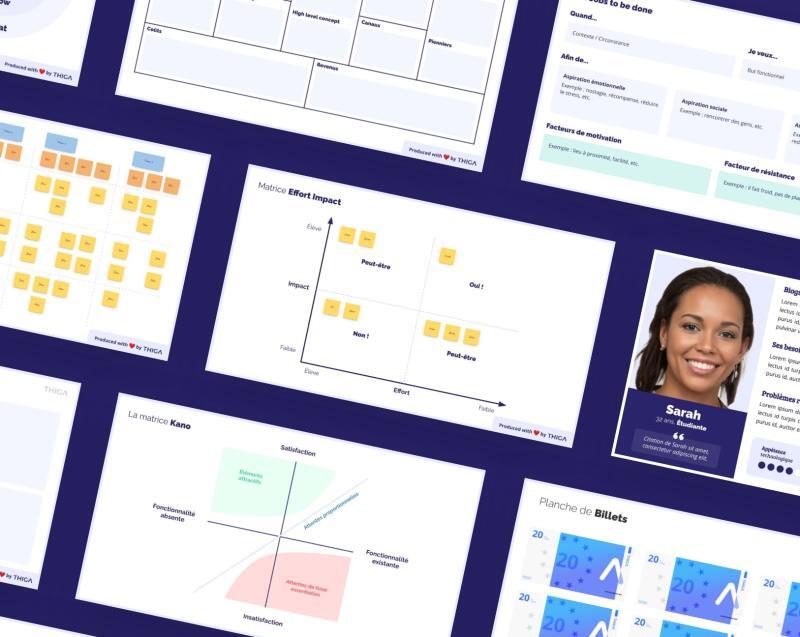
It's a realistic character representative of a segment resulting from user research.
This tool is essential when making decisions about a feature.
02
Impact Effort Matrix
This tool enables you to prioritize features according to expected impact and estimated effort, along 2 axes: Impact/Effort.
It's the ideal tool for coordinating with your team and highlighting low-impact topics.
03
Go Product Roadmap
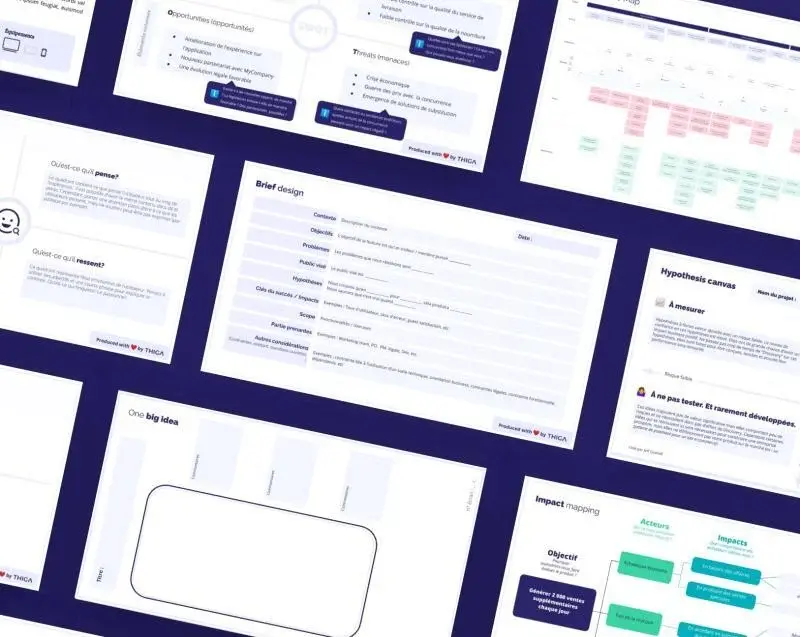
This "Go Product Roadmap" tool is a good way of representing a product roadmap.
For each release, you'll find: the delivery date, the objective or theme of the delivery, the main features included and also the metrics to be tracked.
04
Story Mapping
It's a 2-dimensional representation of the backlog. Functionalities are classified according to 2 axes: user journey and user story priority. This tool gives you the priority of the different functionalities, as well as an initial roadmap of the different releases.
05
Jobs To Be Done
JTBDs enable us to explain why a user chooses one product over another. We don't start from the user's motivations or frustrations, but from his or her appetence for a product, from the point of view of the "job" it will do for him or her.
06
Golden Circle
Simon Sinek gave a TED talk on how certain leaders have inspired through their actions and the way they communicate.
The concept can be summed up in three questions: What, How & Why.
07
Kano
The Kano matrix highlights a user's satisfaction and dissatisfaction with a product and its features.
08
Burndown Chart
It's a graph that lets you track the progress of agile product development over a sprint or an entire project. It shows how much work remains to be done over a short period of time.
09
Lean Canvas
Created by Ash Maurya, this tool is used to synthesize a product vision.
The Lean Canvas is divided into two main sections: the left focuses on the product, the right on the market.
010
MoSCoW
It's a method for prioritizing features by analyzing their importance. It is used to prioritize user stories in the medium term according to the following criteria: Must have; Should have; Could have; Won't have.
11
Definition of Ready
It's the list of expected elements that a user story must meet in order to be considered for development. With its criteria, the Definition of Ready determines whether the user story will go on to development.
12
Product Vision Board
Designed by Roman Pichler, the Product Vision Board is a simplified version of the Business Model Canvas.
It enables you to define your product vision quickly and simply.
13
Buy a feature
Buy a feature is an innovation game in the form of a workshop in which participants are given a limited amount of money to buy a feature.
14
RICE
RICE is a prioritization method based on four criteria: R for Reach, I for Impact, C for Confidence and E for Effort.